Tuesday, April 16, 2013

N is for Needles, California


Once in a while, it is important to note that not all places in California have wonderful weather. I had to laugh at a report published on Wed Aug 15, 2012 in the Daily KOS by Fishoutofwater. I have copied the opening paragraph because the author captured the scene so well.  

“If there is a road to Hell it is I-40 into Needles, California. The combination of intense desert heat and Colorado River valley humidity streaming from the steaming Gulf of California makes it, arguably, the most miserably hot town in America in July and August. In this summer of record heat misery, Needles destroyed the all time world record for hot rain when 115 degrees Fahrenheit rain briefly pelted the town on Monday before it quickly turned to steam and evaporated. Lightning from the storm set vegetation surviving along the riverside afire on both sides of the Colorado, completing the scene of Hell on earth.”

No one has ever denied that it can be hot in Needles but the city fascinates me. As a child, we traveled through Needles once a year on our way to Texas. I may have pointed out on another post that my family went to Texas in the summer and Montana in the winter. Sort of bass-ackwards in terms of weather. 

Needles was always the first stop on our trip. Needles really isn’t that far for us in terms of time but my parents would wake us up early (meaning still dark) so we could drive through the desert before it became unbearable. We are talking 1950’s and no air-conditioning.

As a child with a vivid imagination; Needles was a magical place. I had read Steinbeck and imagined those fleeing the dust bowl. They would cross the desert and the river to find Needles welcoming them to California. It must have been a sanctuary since it was the first California city they encountered. I know that coming back from Texas, Needles meant that we were home. Times have changed and there are more cities on the Arizona side but when I was little, there was only Needles.

Needles still holds its place as a Route 66 stop. While we still sometimes just drive through, there are times that we stop and revisit those attractions. In fact, we will be stopping there in July on our road trip to Missouri. It’s worth the time to visit this piece of American history. Just check the weather before you go.

Monday, April 15, 2013

M is for Missions

All California 4th graders learn about the California missions. I would almost bet that all 4th graders who live anywhere near the California coast visit at least one mission on a field trip. I know that within two hours from my house, there are three. Mission San Juan Capistrano, Mission Basilica San Diego de Alcala, and Mission San Luis Rey are all within reach for a day trip. 

I have written about the missions on another site so I am not going to reinvent the wheel. I have simply pulled my list from there so you can see what’s available in your area or like us, plan a trip to see them all.

If you plan to follow the trail, it is marked by bronze bells that were placed in 1920's. The route called the El Camino Real (The King’s Highway) runs for 650 miles. 

I must not have been a good student in the 4th grade because I learned something when my grandson went on his Mission field trip. All of the Missions are a one-day horseback ride from each other. I always thought that they rode their horses to the next location, stopped and built a mission and then moved forward. They built the first Mission in San Diego. BTW, it is quite beautiful and well worth a visit. The second Mission was built in Carmel, which is 444 miles away. It took 54 years to build 12 Missions between them. 

Many of these Missions are still standing. Many have been restored. Disaster lurked all around them. There were fires, earthquakes, and even a tidal wave. They survived Indian insurrections and the pirate Bouchard. While these Mission were built to share the faith of the Jesuits who brought their religion to California, the Missions had a greater part in the growth of the state. Each one is a treasure.  

Sorry this is a long post but there are 21 missions.

Founded 1769 – 1st mission
San Diego de Alcala, is tucked away is the hills in the middle of San Diego. The freeway is nearby but the mission seems to be lost in time. California’s first historic cemetery is located there.

Founded June 13, 1798 – 18th mission
Considered the most architecturally beautiful of all the missions, it is called the “King of the Missions”. California’s first Pepper Tree still grows there. The Asistencia (sub-mission), San Antonio de Pala founded in 1816, in Pala, CA., is still active.

Founded November 1, 1776 – 7th mission
Mission San Juan Capistrano was founded October 30, 1775 but due to an Indian uprising in San Diego, the mission bells were buried for safety and the group returned to San Diego. They returned a year later, digging up the bells and re-founded the mission. In 1812, an earthquake destroyed the church killing 40 natives as they worshiped. The church is still in ruins. Each year on March 19th, the cliff swallows return from Argentina. This is my favorite Mission. 

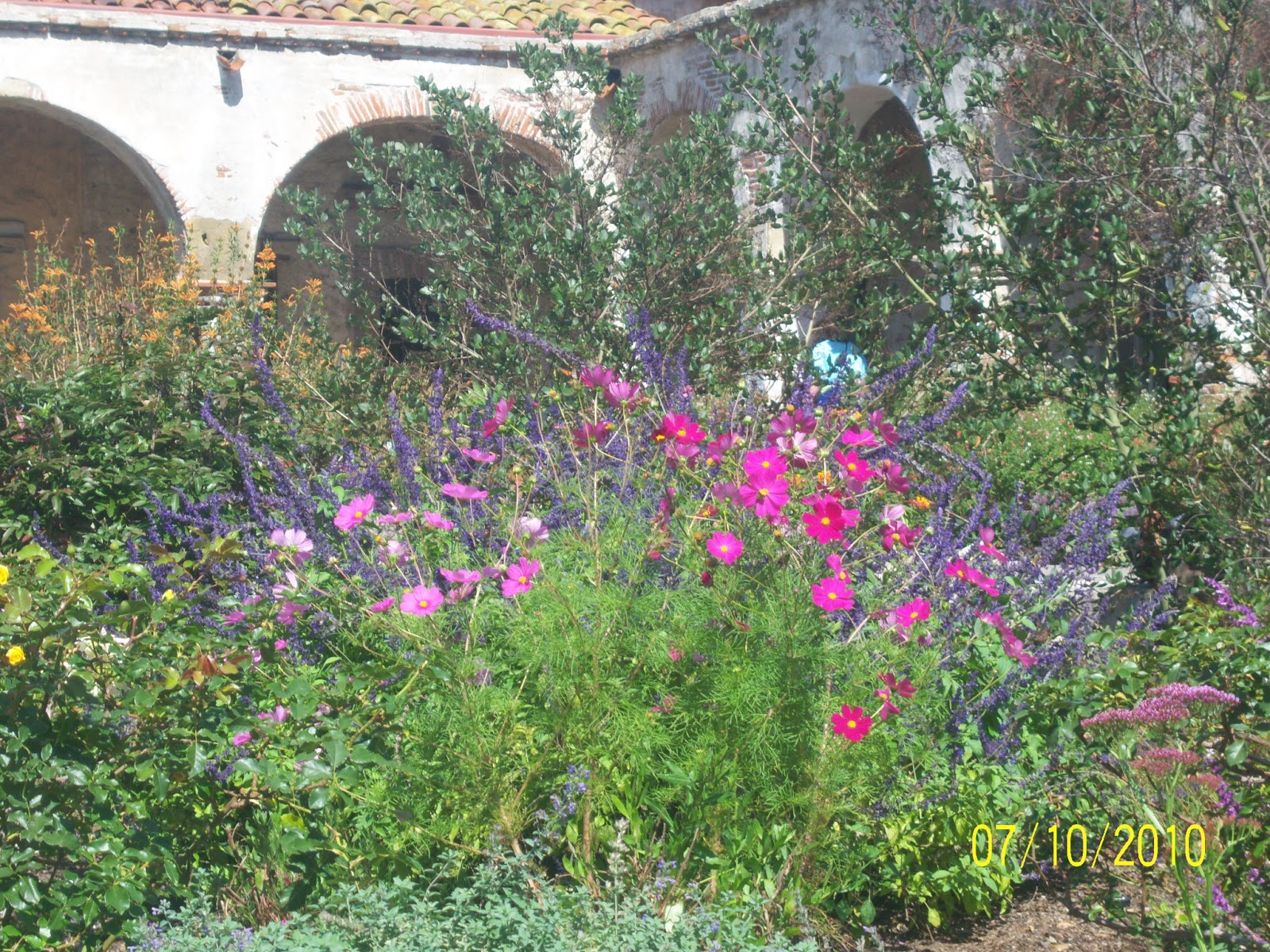
The flowers at Mission San Juan Capistrano never fail to inspire.

Our child's 4th grade field trip where they learned to make adobe bricks. Mission San Juan Capistrano has a great program for children. BTW, the boys loved that adobe is made from clay, water, straw, and manure. The girls...not so much.


Founded September 8, 1771 – 4th mission
The Mission San Gabriel is different from the other missions as it is a fortress with five-foot thick walls. It is nine miles east of Los Angeles. The mission has a treasury of ancient artifacts. It was where I went for my 4th grade field trip more than 50 years ago.

Founded March 31, 1782 – 9th mission and the last founded by Father Serra
This mission suffered multiple earthquakes and a tidal wave. It has been burned to the ground and plundered by the pirate. It was restored in 1957 is a vital part of downtown Ventura.

Founded September 8, 1797 – 17th mission
California’s largest freestanding adobe is here. The mission was destroyed by the 1812 earthquake and abandoned until the 1940’s. In 1971, the buildings were damaged by an earthquake and were not completely repaired until 1974.

Founded December 4, 1786 – 10th mission
The church was destroyed in the 1925 earthquake but has been restored. The mission sits on a hill overlooking the city and the ocean. Part of the city’s water system comes from the original mission’s water works.

Founded September 17, 1804 – 19th mission
Mission Santa Ines managed to survive all the earthquakes. It is inland in the town of Solvang, known for its Danish population. The gardens at the mission are maintained as they were when the mission was new.

Founded December 8, 1787 – 11th mission
Mission La Purisima Conception is a California State Park. Docents provide tours and demonstrate the trades and the ways of the mission. The gardens are a collection of all the plants from the early missions.  

Founded September 1, 1772 – 5th mission
This mission was the first to use tile on the roof to stop the Indians from setting the thatched roof on fire with flaming arrows. This mission also fell into disrepair and was restored during the 1930’s.

Founded July 25, 1797 – 16th mission
The painted walls and ceilings are the best preserved of all the missions. However, disaster struck. On December 22, 2003, a 6.5 earthquake hit the area. It was centered 3.5 miles from the mission. All the buildings were closed to the public until October 2, 2009 when the mission reopened.  

Founded July 14, 1771 – 3rd mission
The mission sits 5 miles back from the main road. It is unchanged and it is believed to be the only one that Father Serra would recognize today. It has been restored to its original condition.

13th mission
The mission restoration started in 1954. There were 3 floods but the third one left the mission in ruins. Today only the chapel and one wing of the quadrangle are completely restored. There is a small museum on the grounds.

Founded June 3, 1770 – 2nd mission
Thought to be Father Serra favorite mission, he is also buried here. The mission was left in ruins for thirty years and the roof on the church was restored in 1884. It was not aesthetically pleasing so in 1930, the church roof was replaced. This is considered the most beautiful of all the missions.

Founded June 24, 1797 – 15th mission
This mission sits directly on the San Andreas Fault and in 1906 the earthquake destroyed the side walls of the church. They were restored in 1976. Music was important at this mission and was taught to the Indians as well. The tiles in the church floors have animal prints created by animals walking on them as the tiles dried outside.

Founded August 29, 1771 – 12th mission
Now a California State Park, the mission was completed in the 1790’s. However, it was damaged by several earthquakes and in 1857, most of it collapsed. The mission was abandoned due to the earthquakes and the neighboring pueblo with thieves and ex-convicts. Today, the Adobe built in 1791 has been restored.

Founded January 12, 1777 – 8th mission
This mission had five different locations. The first, too close to the Guadalupe River was moved to a temporary second site. The third was blessed by Father Serra but was destroyed by an earthquake in 1818. The fourth was another temporary location and the fifth was built in 1822. Not so much luck with this either as it was destroyed by a fire in 1926. However, it was rebuilt in 1928 and became the Santa Clara University.

Founded June 11, 1797 – 14th mission
There is some confusion over the name of this mission. In the early 1900’s a sign was put on one of the mission buildings calling it the "Mission San Jose de Guadalupe”. This name has been used in many publications and is still misused today.

Founded June 29, 1776 – 6th mission
The mission survived the 1906 earthquake and is the oldest building in the city with the only remaining cemetery within the city limits. Commonly referred to as Mission Delores, it is the only intact mission founded by Father Serra.

Founded December 14, 1817 – 20th mission
This was not meant to be a full mission but a branch of the Mission San Francisco de Asis to treat sick Indians. It became so important that it was promoted to a full mission on October 19, 1822. This mission did not fare well. It was torn down in 1870 to be used as firewood. There is a replica of the chapel on the site.

Founded July 4, 1823 – 21st mission
Mission San Francisco Solano is part of the Sonoma State Historic Park. It’s in the Sonoma wine-country and the first vines were planted by the priests. The original church washed away and the restored church was built in 1840. It was the site of the Bear Flag Revolt, the effort to establish California as a republic in 1846.


Sunday, April 14, 2013

It's Sunday

It's stressed out Sunday. I still don't like my "M" topic and that means I need to get my act together and find another California word for Tuesday. I actually have great topics for X and Z.

I got a Liebster Award. I need to find 11 blogs. That's not all that hard, I have found some great bloggers.


 To accept the award:

  • Post the award on our blogs
  • Thank the lovely blogger(s) who gave us the award and link back to their site(s)
  • Post 11 random facts about ourselves
  • Answer 11 questions that the presenter of the award has asked us
  • Nominate 11 new bloggers with fewer than 200 followers that we want to pass the award on to
  • Ask our nominees 11 questions
I must admit that I don't totally understand this but it is fun so I will do it.

I need to go to a friend's house and feed her four dogs. Fortunately, they are friendly and loving and I don't mind taking care of them.

I have to wake up the boy. He's always grumpy in the morning. He wants to go to Knott's Berry Farm. We have season passes but it's yucky outside so not the best weather. I think I will talk him into going to the movies instead.

There is no food in the house. We need to go shopping. My husband wants new dishes and is reading cookbooks. He doesn't cook, so he finds all these wonderful recipes for me to make.  

My computer has been ugly. I keep losing connection. Now I am behind on my reading and commenting. All I want to do is play on the computer and catch up. How can I do that when others are demanding my time?

Fortunately, Spring Break (the former Easter Vacation) is over today and the boy goes back to school tomorrow. My "M" post on the California Missions is done for tomorrow. Tomorrow, I will do the Liebster Award, find another "N" topic for Tuesday and spend the quiet time with the boy is school, catching up on the posts. Let the school deal with the grumpy boy.

Off to wake up the boy, feed the dogs, and go see the new movie "42". After all, we are a baseball family.

Saturday, April 13, 2013

L is for the La Brea Tar Pits


Los Angeles was not always my favorite place. As a child, I hated going there because I was born before there were freeways. However, I never said no to a trip to the Tar Pits. They have always been called the La Brea Tar Pits but here's a little secret. There is no tar, it is actually asphalt. Click on the link to be taken to their website. They have a very good map of the park layout.

The Tar Pits can be a little tricky to find. It sits in the midst of trendy shop and gourmet eateries. This area of Wiltshire Blvd has come back to life after years of semi-decay and it is quite upscale. The Tar Pits are surrounded by trees and I actually missed it last year.

It seems that I am having problems finding current photos but I did find pictures taken with the statues that surrounded the pit in 1948, before I was born. Our family love affair with the Tar Pits goes way back.


Summer 1948. My parents, newly married.
My mom posing.

My dad and my grandpa
My all-time favorite. Grandpa's hat on the tail of the Saber-Tooth Tiger.
The landscape has changed. Many of these statures are gone. There is still one in the main pit in front of the museum.

Be careful where you walk here. The underground asphalt tends to come up where it wants. The last time we were there, one of the parking places was blocked off because the asphalt had oozed up through the space. It also appears in the grassy areas.

This is a fun place to go. The museum has several interactive exhibits that thrill and delight young and old. A film explains what is happening there. Not to be missed, the glassed off room called Fish Bowl where paleontologists painstakingly try to match bone fragments. It is fascinating.

Outside is the main pit of asphalt that is fenced off. You can smell the methane gas as it forms large bubbles in the pond. On the other side of the park, there is an open pit where archeologists and paleontologists are still digging for bones.

I did find a sort of current photo of my grandson taken in 2009. A skeleton of this bear was found there. 


We love it when family comes to visit. This is our go-to place to share. Then, we head back on Wiltshire Blvd towards downtown and eat at the Original Pantry on Figueroa and Ninth.  Best day trip ever!

Friday, April 12, 2013

K is for Kings Canyon National Park


Kings Canyon National Park and Sequoia National Park are often lumped together as one. They are instead, two separate parks that have different features. Both of them are overshadowed by the more well-known Yosemite National Park.  


We have spent years in all three parks. I can’t find my current pictures of Kings Canyon but I did find pictures of a vacation we took in 1960. We camped in Kings Canyon National General Grant Grove with my aunt, uncle, and cousins. This campground is no longer there. Traces of civilization have been removed from the park in order to preserve the forest.

Uncle Howard, Billy, Aunt Anne, my mom Ruby and dad Ernie in the back row. Stuart, Gary, Me, my brother Marlin, and Patty in the front row.

I am not always a fan of progress. However, in order to preserve the grove, I do applaud the removal of all the commercial sites. We are, and have always been, responsible campers but just the traffic that used to run through the groves hurts the ecological systems. The park has more than 500 Native American archeological sites

Even with the changes, Kings Canyon is spectacular. The General Grant Grove, only a small part of the park, is part of one of the largest remaining grove of giant Sequoias. Sequoia National Park shares these giants.

My dad and I in front of the General Giant.

The rest of Kings Canyon is just what it says. A canyon carved out by glaciers. It is similar to Yosemite but is not as accessible. Truly a magnificent sight, it is preserved as it was. Visitors can visit Boyden Cave that has tours of this geological site with stalactites, stalagmites and a subterranean stream. There is also a bat grotto   

I recommend this park and Sequoia to anyone who has not been there. Before going, check the website. As of today, some of the roads in are still closed until the snow melts. 

Various camping photos from that trip. 

Me, my brother and Patty.


Patty and I touring the forest.

My uncle and dad. The car is a 1958 Opal Kadett Station Wagon that I got for my 16th birthday several years later.
 
Sort of posed. The boys were being silly as usual.

Thursday, April 11, 2013

J is for Julian, California


Julian, California is not a secret but it’s not as well known as some of the other California historical districts. Julian is very proud of its heritage and even offers a History Hunt Card to insure that historical sites are not missed.

Our love affair with Julian doesn’t have a lot to do with the history. We know Confederate soldiers settled it after the Civil War. The town was named for Mike Julian who eventually became the San Diego County Assessor. We actually go there for the apples pies and the camping.

There are many state and county campgrounds surrounding the area. You have your pick of semi-desert to forested areas. However, I do have to give a nod to the private campground, Pinecrest. As a vintage trailer aficionado, I have enjoyed touring this campground with close to 100 vintage trailers. I have three vintage trailers of my own. Although it is a private campground, they do rent some of the vintage trailers for a unique camping experience. It’s sort of a California version of the Shady Dell campground in Bixby, Arizona.

The other reasons to visit Julian are the pies and all things apple. I can make my own apple pies, but why? Several places specialize in apple goodies and I like them all.

If you are not sold on the history, the camping, or the apple pies, Julian also has some interesting shops, unique restaurants, and wine tasting.

Looking for a day trip that has something for everyone, try Julian. Save me a piece of pie.

Wednesday, April 10, 2013

I is for Indio, CA


Romance and Sex Life of the Date 

OK I said it, you know, the “S” word. 

Photo credit: http://www.flickr.com/photos/irishfireside/3262015686/
 Actually, at Shields Date Garden, the sex life of the date is a proud heritage. In 1924, Floyd and Bess shields came to California and built a business to grow dates. Mr. Shields also lectured his customers about the date culture. The lecture became so popular he created a 15-minute film that plays today. I must say we were tickled with the film and learned more about dates than we thought possible.

Located on Hwy 111, just beyond Palm Springs, you will find this delightful place with not only the film but also a shop and restaurant.  BTW, in Cabazon, Hadley’s Fruit Orchard has been serving date shakes for as long as I remember. We learned they are made with the Shield’s crystals. They are quite tasty!

My photo

So, what else is in Indio?

The Coachella Valley History Museum is housed in a 1926 adobe called the Smiley-Tyler House. There is also the 1909 Indio Schoolhouse. There are several gardens and one that spotlights the oldest Cork Oak tree in the Coachella Valley. What I really like is the archives. It includes the history of Coachella Valley and is open to researchers. As a family history aficionado, that’s a great resource.

While I am not into golf, several of my family members are and they have discovered there are 6 golf courses. Yep 6, and that was after they made the rounds in Palm Springs.

I would call this the piece of resistance. We have talked about the Indio International Tamale Festival for the 20 years we have lived here and have yet to make it. This year, we are going. It will be held from December 7 through December 8, 2013 and is held in downtown. The Food Network has ranked this as one of the top 10 “All-American Food Festivals.”

On December 4, 1999, they won the Guinness World Record for the largest tamale. It was over 1 foot in diameter and 40 feet long. My husband swears he can eat that all by himself. Look for us there.

My Blog List